Memory & Databases
The essential layer beneath reliable AI systems.
Modern AI needs more than vector databases. agenticonsult designs complete memory architectures — the knowledge layer that makes AI systems reliable and context-aware.
Why AI systems forget
Most AI implementations fail not because of the model — they fail because of missing memory. Without a memory architecture, an AI system has no access to company knowledge, no recollection of past interactions, and no context for decisions. It responds — but it does not know what it is doing.
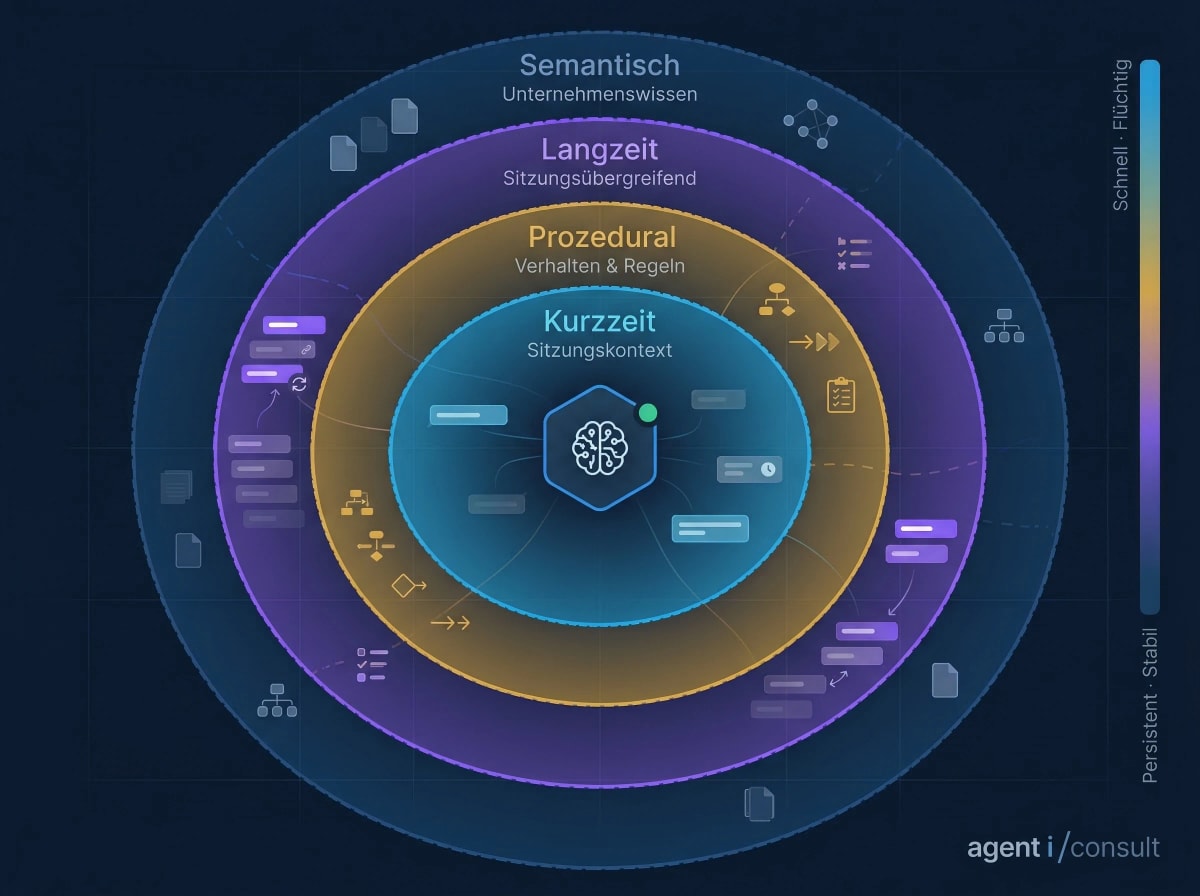
The 4 types of AI memory
A complete memory system combines all four types. Missing layers lead to inconsistent results, unnecessary context loss, and an ever-growing burden of manual correction.
Short-term memory
Session-bound context — what happens in the current conversation or workflow. Transient in nature, but crucial for coherence within an interaction.
Long-term memory
Persistent, cross-session memory. Without long-term memory, every AI system must relearn the same things repeatedly — inefficient and error-prone.
Semantic knowledge
Structured factual knowledge about the world, your company, and your domain. The content of your knowledge base — the long-term knowledge that allows AI systems to work with facts.
Procedural memory
Knowledge of procedures, patterns, and behaviours. How does an agent respond to certain situations? What quality standards apply? This layer governs consistency and reliability.
Retrieval architecture: From single step to loop
Simple RAG — single search, insert, respond — is no longer sufficient for production systems. In 2026, hybrid RAG is the standard, and agentic RAG is establishing itself for demanding use cases.
Vector retrieval
Semantic similarity search — finds conceptually related content, even when exact terms do not match.
Knowledge graph retrieval
Query structured relationships between data points. Ideal for multi-step reasoning: who knows whom? What is connected to what?
Hybrid RAG
Combination of vector search and graph queries. The production standard in 2026 — delivers both semantic and structural relevance.
Agentic RAG
The agent dynamically decides what to retrieve, reformulates queries, and iterates — retrieval as a loop, not a one-time step.
The guiding principle: Retrieval architecture is not an end in itself. The right strategy depends on your data, your use case, and the required precision. The recommendation is always the simplest approach that reliably meets requirements — scaling only when it is provably necessary.
The right solution for your needs
Not every system requires full complexity. The recommendation is always the simplest architecture that reliably meets your requirements.
Simple vector search
For structured knowledge bases, FAQ systems, and document collections. Quick to set up, cost-efficient, sufficient for most use cases.
Hybrid RAG
When both semantic similarity and precise facts are needed. The production standard for medium to large knowledge bases.
Complete memory architecture
For AI systems that need to learn across sessions, query relationships between data points, and act with context.
What agenticonsult delivers
agenticonsult designs your complete memory and database architecture and delivers all the frameworks and guides your team needs to build independently. No black box — everything documented, explained, and yours to keep.
Concrete deliverables
The approach
Knowledge analysis
What knowledge does your AI system need? What data sources exist? agenticonsult analyses your information landscape and identifies the most important knowledge assets.
Architecture design
Design of the complete memory architecture: which memory types are needed? Which retrieval strategy fits your use case?
Framework delivery
Handover of all configuration documents, setup guides, and templates. Your team can begin building independently.
Guided onboarding
Guidance through the first steps: knowledge base ingestion, retrieval testing, and quality review of results.
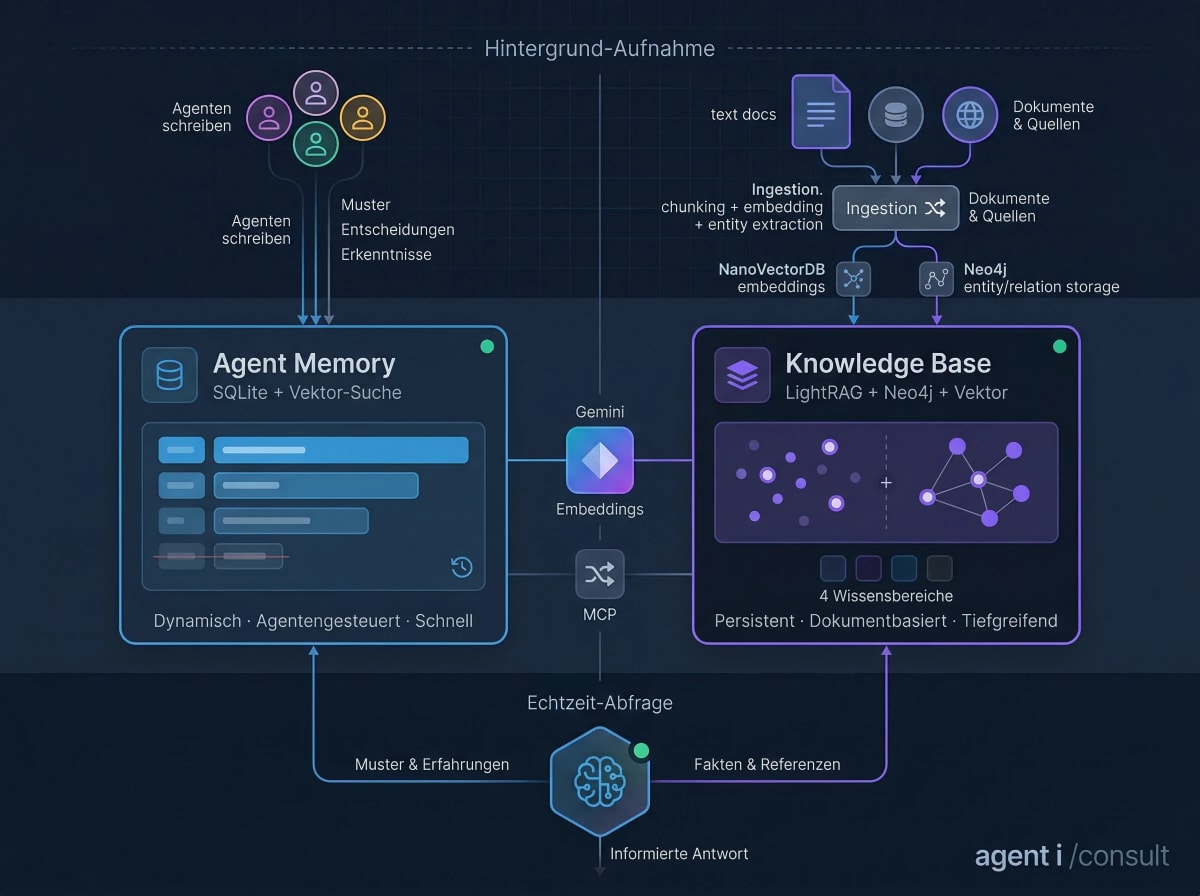
Knowledge graph + vector: The best of both worlds
Knowledge graphs store structured relationships between data points — ideal for multi-step reasoning and precise fact queries. Vector databases enable semantic search over unstructured text. Combined, the result is a system that delivers both precise facts and contextual relationships.
Hallucinations arise when the model has no reliable knowledge source. Hybrid RAG addresses this structurally — not through better prompts, but through better architecture.
The infrastructure is the proof
What agenticonsult designs, it operates — daily, in production. The memory architectures and retrieval strategies recommended to clients run in agenticonsult's own system.
Operated in production, not demonstrated:
Ready for AI systems with real memory?
Discuss your requirements — whether a simple knowledge base or a complete multi-layer memory architecture. agenticonsult designs the system that fits your use case.